
This guide introduces the materials you will need when starting the online Nihonga lessons.
Where possible, I have included direct links to art supply stores so you can purchase the materials easily.
I also suggest suitable alternatives if traditional Nihonga materials are difficult to obtain in your country.
Materials Available from the Sekaido Online Shop
(International Shipping Available)
Gansai (Traditional Japanese Watercolors)
A set with more colors is more convenient. I recommend a set with at least 18 colors.
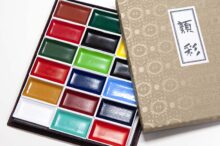
Link to the Sekaido Online Shop
Although ordinary watercolors can also be used,
Gansai are formulated to resemble the color characteristics of
Iwa-enogu (traditional Japanese mineral pigments),
allowing you to achieve a more authentic Nihonga appearance.
Brushes
Even if you use ordinary watercolors, I recommend using brushes designed for Nihonga whenever possible.
They make it easier to achieve traditional Nihonga-style brushwork.
You will need at least three types of brushes:
- Round brush (for general painting)
- Menso brush (for fine lines and details)
- Flat brush
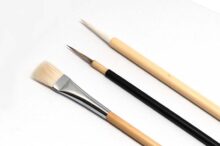
Link to the Sekaido Online Shop
If Nihonga brushes are not available, Chinese brushes or watercolor brushes can also be used.
Palette
A palette is necessary for picking up paint, checking colors, and mixing pigments.
Any palette is fine; it does not have to be a traditional Japanese plum-shaped ceramic palette.
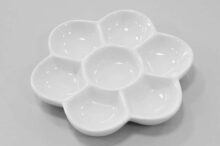
Link to the Sekaido Online Shop
Brush Washer and Cleaning Cloth
Any brush washer or cleaning cloth is acceptable.
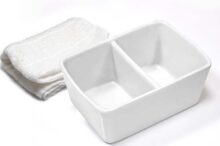
Link to the Sekaido Online Shop
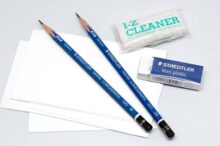
Pencil, Eraser, and Practice Paper
Any ordinary products are fine.
For pencils, HB, B, or 2B are all suitable.
A kneaded eraser is even better than a standard eraser.
A hair dryer is also useful because it speeds up the drying process.
Drawing Paper or Sketchbook
Traditional Nihonga is painted on Japanese paper (washi),
but washi can be difficult for beginners and may also be difficult to obtain.
Drawing paper or sketchbooks with a smooth surface are good alternatives
and can produce results similar to Nihonga.
Professional watercolor paper usually has a rough texture,
so it is not particularly suitable for Nihonga techniques.
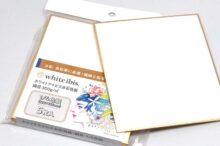
Shikishi (Japanese Painting Board)
Shikishi comes in several sizes, but the standard size is called O-shikishi.
If you are purchasing from Sekaido, I recommend Holbein White Ibis Watercolor Shikishi (Fine Grain).
If you purchase from a Nihonga art supply store, choose Dosa-sized Gasenshi Shikishi.
Link to the Sekaido Online Shop
For Those Who Want Professional Nihonga Materials
The materials below are more expensive, but they are of excellent quality.
If you have an opportunity to visit Japan, you may wish to consider purchasing them.
Please note that the Uematsu Online Shop either does not offer international shipping or its shipping policy is unclear.
Brushes
Sokumyō Brush
The Sokumyō Brush is originally designed for line drawing, making it excellent for painting fine details.
It is also versatile enough to cover moderately large areas.
For your first brush, I recommend the Large size.
Link to the Uematsu Online Shop
Menso Brush
A Menso Brush is used for painting fine lines.
I recommend the Chōho Shirotanuki Menso Brush.
For your first brush, I recommend the Small size.
Link to the Uematsu Online Shop
Flat Brush
A flat brush is used for painting medium-sized areas evenly.
For your first brush, I recommend Size No. 6.
Once you become more experienced, consider adding No. 4 or No. 5.
Unlike many other brushes, a good flat brush can last for many years,
so I recommend purchasing the Special Grade (“Tokusei”)version.
Link to the Uematsu Online Shop
Hake Brush
A Hake Brush is used for painting larger areas than a flat brush.
For paintings about the size of a shikishi board,
a brush 1.5 sun (approximately 4.4 cm) wide is easy to use.
Since this brush also lasts for many years,
I recommend purchasing the Special Grade (“Tokusei”)version.
Link to the Uematsu Online Shop
New round brushes are stiffened with Funori (a natural seaweed adhesive).
Before using a new brush, soak it thoroughly in water to soften it all the way to the base of the bristles.
The protective cap is not needed and may be discarded.
Never store brushes while they are still damp, as this may damage them.
After each use, wash them thoroughly and allow them to dry completely in a well-ventilated place.
Shikishi
The Uematsu Online Shop does not sell shikishi boards online,
but they are usually available in the physical store.
When purchasing, ask for O-shikishi made from Dosa-sized Gasenshi.
Shikishi that has not been treated with Dosa absorbs water too quickly,
causing the paint to bleed and making it difficult to paint naturally.